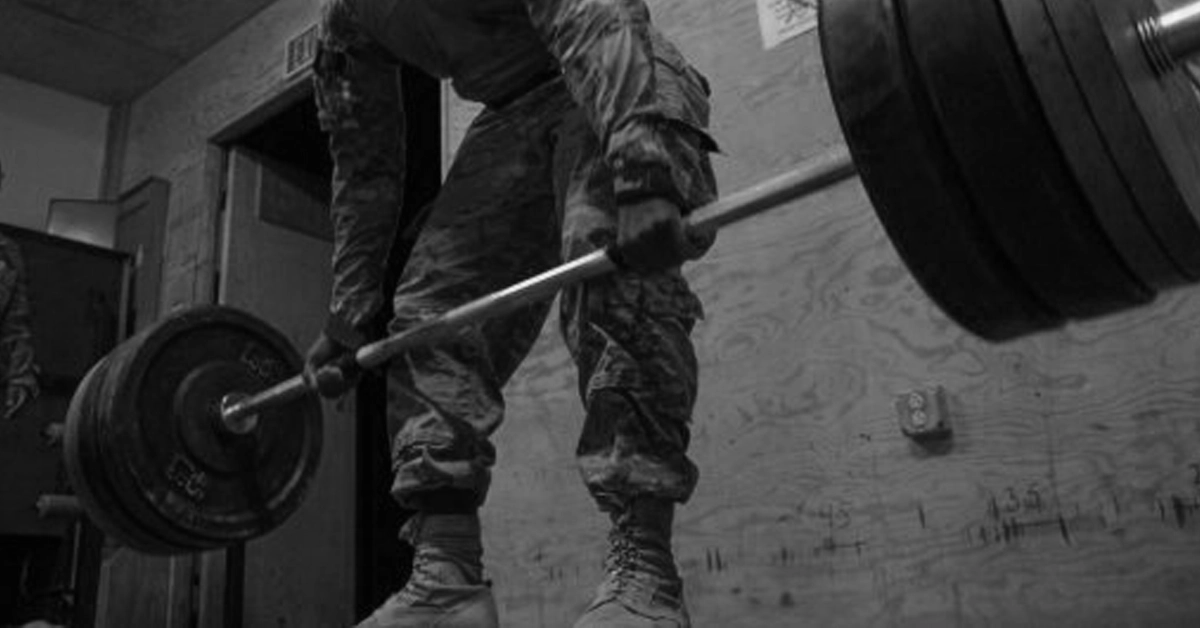
How to add 30 pounds to your deadlift in 30 days
Heavy barbells are great. Heavy bodies can become a liability.
The goal — especially for military athletes — is to be as strong as possible without packing on unnecessary mass. That means skill mastery matters more than just adding muscle. The more neurologically efficient you are at a movement, the stronger you get without weighing another pound more.
This is the program I used to prove it.
How I added 30 pounds to my deadlift without changing my body weight
Years ago I was stuck at a 355-pound deadlift. I wasn’t spending much focused time on it, and at around 160 pounds bodyweight I was reasonably happy with that number — but I wanted more and didn’t have a ton of extra time to dedicate to it.
So I did what I always do when I need something simple and effective: I turned to Pavel Tsatsouline’s Power to the People.
The prescription inside is almost aggressively simple. I followed it for just over three weeks and moved my deadlift 1RM from 355 to 385 without a single pound of body weight change.
That’s 30 pounds in less than a month. From practicing the lift — not from grinding myself into the floor.
The program: structured wave progression
Here’s the exact protocol, using 200 pounds as a working example.
Set 1: 5 reps at your starting weight (200 lb) Rest: 60–90 seconds Set 2: 5 reps at 90% of Set 1 (180 lb)
Add 10 pounds each workout. That’s it.
Ten reps per day, five days per week.
A few things to note:
- Lift and lower each rep with control. No slamming, no bouncing, no losing position at the bottom. The tension through the full range of motion is the point.
- Early in the program this will feel easy. That’s intentional. This is supplemental strength practice — it shouldn’t wreck your recovery or interfere with everything else you’re training.
- As the weights climb, it gets spicy. Monitor how you’re recovering day to day and adjust if needed.
Results will vary based on training experience. If you’ve been pulling heavy for years, a 5–10 pound improvement is a solid win. If you’re newer to heavy lifting, you should see bigger jumps.
Why this works
Pavel puts it plainly: you need to learn how to use the capacity you already have before you worry about adding more muscle.
Most people trying to get stronger are chasing more — more weight, more volume, more sessions. This program forces the opposite. You practice the movement with intent, every single day, and let neural efficiency do the work.
For a deeper look at the two factors that actually drive strength gains — hypertrophy and skill mastery — this breakdown of absolute strength training is worth reading before you start.
Pair it with a second lift
I rarely run this program with just the deadlift. Pairing it with a second major lift gets you twice the practice in the same session time.
Good combinations:
- Deadlift / Press
- Back Squat / Weighted Pull-Up
- Bench Press / Front Squat
Complete both sets of the first lift, then move to both sets of the second. Total time investment is minimal. Strength gains are not.
Start this week
If getting stronger is on your list, give this four weeks. It asks almost nothing from you in terms of time — ten reps, twice through, five days a week. The consistency is what makes it work.
Track your starting weight, add 10 pounds per session, and report back.
If you want a full strength program that builds this kind of structured progression across all your major lifts, Strategic Strength is built exactly for that — squat, press, pull, and carry, laid out over eight weeks.