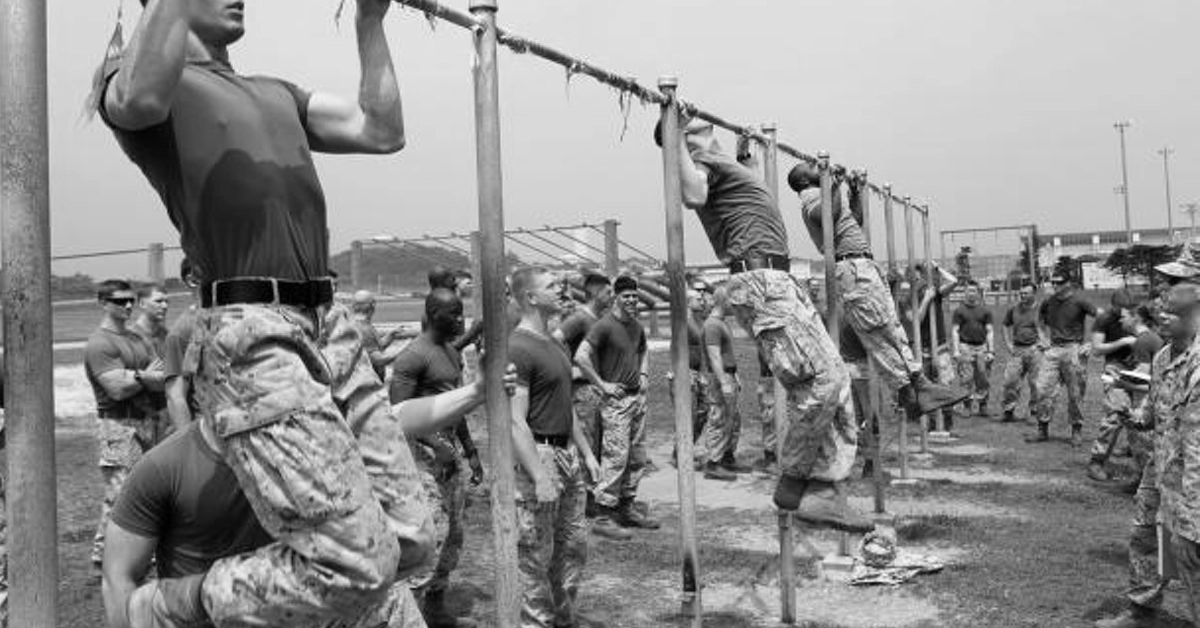
How to Improve Your Pull-Ups: The Grease the Groove Method
In 2001, preparing to head off to Officer Candidates School, I had a problem.
My 3-mile run was nowhere near where it needed to be. My crunches were fine. But pull-ups — strict, dead-hang, USMC-standard pull-ups — were a genuine weak point. I was doing 3 or 4 before form started breaking down. That was not going to cut it.
So I bought a $25 doorframe pull-up bar, found a training method called Grease the Groove, and went to work.
Six weeks later I hit 18 strict pull-ups on my PFT — six more than my previous best. By the time I arrived at OCS that summer, I was hitting 20 with no problem. And by the time I was deployed, I had worked up to 26, maintained on the bustle rack of a tank using the exact same method.
No dedicated pull-up program. No periodization. No special equipment. Just one deceptively simple approach applied consistently.
Here is how it works.
What Is Grease the Groove?
Grease the Groove (GTG) is a training method popularized by Pavel Tsatsouline in his book Power to the People. The concept is straightforward: perform submaximal sets of a movement frequently throughout the day, with full recovery between sets, using perfect form every single rep.
That is it.
No sets to failure. No burn-out finishers. No structured workout around it. Just clean, frequent, submaximal practice.
The mechanism is neurological, not muscular. You are not building the movement through fatigue and damage — you are building the motor pattern through repetition. Myelinating the nerve pathways. Teaching your body to recruit the right muscles efficiently. Making the movement automatic.
Perfect practice makes permanent. Every sloppy rep teaches your nervous system a sloppy pattern. Every clean rep reinforces the right one. GTG only works if the quality stays high — which is exactly why submaximal effort is the point, not a compromise.
How to Apply It
The protocol is simple:
- Install a pull-up bar somewhere you pass frequently — a doorframe, a garage beam, anywhere that puts it in your daily path
- Every time you walk under it, stop and do a set
- The set should be roughly 50% of your current max — never to failure, never close to it
- Form must be perfect: dead hang start, chin clears the bar, controlled descent, full extension at the bottom
- Do this throughout your day, every day
If your current max is 10 strict pull-ups, you are doing sets of 5. If your max is 4, you are doing sets of 2. The number does not matter — the quality and frequency do.
There is no prescribed number of sets per day. The more times you pass the bar and stop, the more practice reps you accumulate. On a full day at home I would easily hit 50–80 quality reps without ever breaking a sweat or going anywhere near failure.
Why This Works for Military Athletes Specifically
Most strength training methods require a warm-up, a ramp-up, specific conditions. GTG does not. You stop, you do your reps, you move on.
That matters in the military context because it trains you to perform on demand — not just when conditions are perfect and you’re warmed up and ready. The ability to stop what you’re doing, execute a near-maximal physical effort, and carry on is genuinely useful when your job occasionally requires exactly that.
I maintained 26 strict pull-ups while deployed by doing sets on the bustle rack of my tank every time we stopped. No gym. No program. No excuses.
It also works for push-ups, squats, and barbell lifts — anywhere you want to build strength and volume in a movement without taxing your recovery. The push-up version of this method runs on the same principle and produces the same results.
Can’t Do a Single Pull-Up Yet?
Scale the movement, not the method.
Options that work:
- Assisted pull-ups using a band or machine to reduce load
- Inverted rows (feet on floor, body at an angle, pulling to a bar)
- Flexed arm hangs — jump to the top position and lower yourself as slowly as possible
- Negative pull-ups — jump to the top, take 5–10 seconds to lower yourself to a dead hang
Apply the same GTG approach to whichever scaled version you can perform with clean mechanics. As those reps get easier, reduce the assistance or progress to the next variation.
The video below demonstrates some of the most common scaling options:
How to Progress
Once the GTG habit is established and your daily rep quality is consistent, progress is simple: add one rep to each set per week.
Week 1: sets of 5. Week 2: sets of 6. Week 3: sets of 7.
Retest your max every 3–4 weeks. Adjust your working set number to stay at roughly 50% of your new max. Repeat.
The progression is boring. The results are not.
Take It Further
If you want a structured 12-week program built specifically around pull-up improvement — with three levels of difficulty and a clear progression path — the Pull-Up Domination program is exactly that. Fifteen dollars, yours to keep.
And if pull-ups are just one piece of a broader PFT prep goal, the GTG approach pairs well with the push-up improvement method for a simple, equipment-free way to move both scores in the right direction simultaneously.
The method is simple. The bar is right there. Go do a set.