Training Specificity: Why Your Goals Determine Your Program
The most common training mistake I see is people following a program that has nothing to do with what they actually want to accomplish.
They want to improve their run time, so they do CrossFit. They want to get stronger, so they do long slow distance runs. They want to pass selection, so they follow a generic military fitness program that was not designed for their specific selection.
The result is always the same: a lot of training, modest results, and persistent frustration.
The fix starts with understanding the SAID principle — Specific Adaptation to Imposed Demands — and using it deliberately rather than accidentally.
What Training Specificity Actually Means
Your body adapts specifically to the demands you place on it. Not generally, not approximately — specifically.
This plays out across four dimensions:
Metabolic specificity: Your energy systems adapt to how they are trained. Short, high-intensity efforts with full recovery (like sprint intervals) develop your anaerobic system. Longer, sustained moderate efforts develop your aerobic system. If you only ever train one, the other atrophies. For military athletes who need both, high-intensity interval training is the most efficient tool because it taxes both systems in the same session.
Biomechanical specificity: Your body gets better at the exact movement patterns you practice. Want a stronger squat? Squatting will always outperform leg extensions. Need to pick up a heavy casualty, clean him to a carry position, and move — but you have never trained a full range of motion deadlift or clean? You will struggle. The movement must be trained to be available under pressure.
Psychological specificity: Mental effort and intent during training directly influence strength and power gains. Research has shown that consciously focusing on producing maximal force during a lift significantly improves strength outcomes. Knowing what a movement requires before you execute it also matters — anticipated effort shapes motor recruitment. This is the neurological side of mental training for performance.
Testing specificity: If you are training for a specific fitness test, training the exact conditions of that test matters. The order of events, the rest periods between them, the specific movements — all of it should be practiced as it will be performed. This is why your PFT score goes up during basic training. You are doing the test, repeatedly, under test conditions.
When to Get Specific (And When Not To)
Training specificity is a powerful tool in the right context and a liability in the wrong one.
Short timeline (under 30 days): Get hyper-focused on your weaknesses relative to the specific event. There is not enough time to build a broad base — concentrate your effort on the things that will move your score or performance the most.
Medium timeline (30–90 days): A well-rounded program that emphasizes event-specific tasks while also addressing weaknesses. You have time to build both general fitness and specific capability simultaneously.
Long timeline (90+ days): Use this window to build genuine fitness — not just test fitness. Turn weaknesses into strengths. Prepare for the known requirements and buffer for the unknown ones.
The classic failure mode at the short end: someone spends 30 days doing nothing but push-ups, sit-ups, and timed runs — and passes the PFT while being completely useless under 80 pounds of kit. That is a narrow win with a wide cost.
The classic failure mode at the long end: someone spends 18 months training for a selection using a general fitness program without ever simulating the specific demands of the selection. The aerobic base is there. The specific movement patterns and mental stress inoculation are not.
The Pull-Up Example
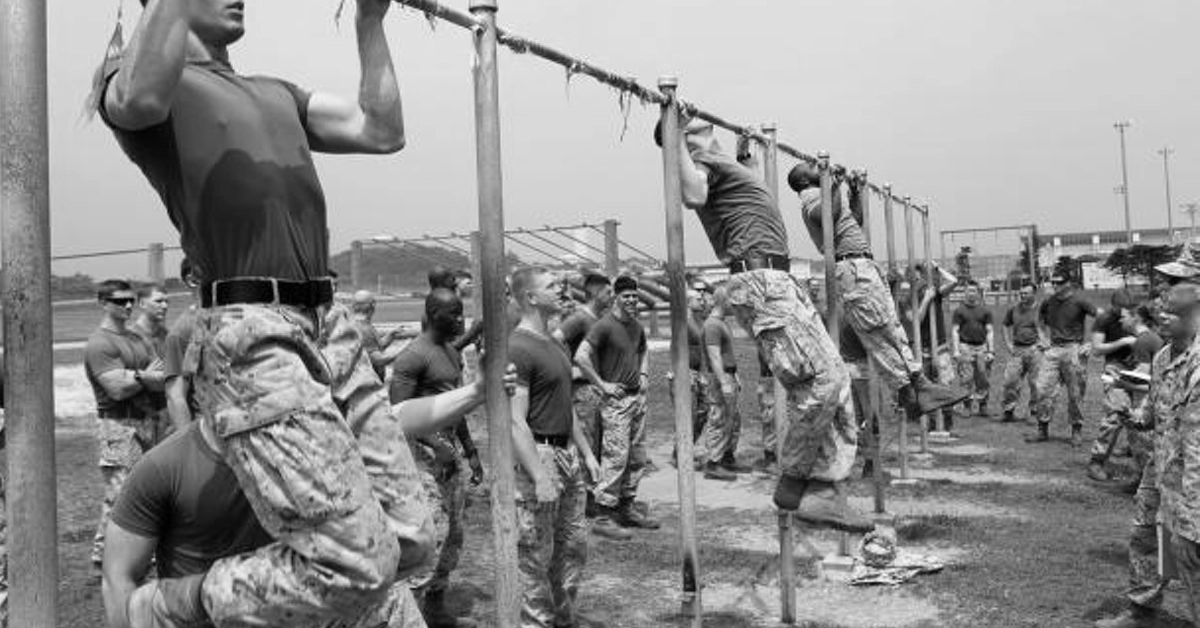
Before heading to OCS, pull-ups were a genuine weakness — barely getting to 10 dead-hang reps. The fix was not a sophisticated program. It was a $20 doorway pull-up bar and a simple rule: do as many good pull-ups as possible every time you walk through the door.
Eighteen dead-hang pull-ups at OCS. Eventually 26, maintained through deployment on the bustle rack of a tank.
This is training specificity at its most basic. If you want to get better at pull-ups, do pull-ups. If you want to run faster, run faster. If you want to max your PFT, train the PFT movements under PFT conditions.
Simple — not easy to sustain, but simple.
The Limitation
The danger of chasing specificity too hard is the athlete with a perfect PFT score who crumbles the moment the training environment changes. Narrow specialization produces narrow capability. For military and tactical athletes who need to be competent across a wide range of unknown demands, general physical preparedness has to remain the foundation.
Specificity is the tool you use to sharpen a particular edge when you need it — not the entire approach to your training life.
Know what you are training for. Match your program to that goal. But never let chasing one number hollow out the general fitness that makes you useful when the situation changes.
The 4 pillars of athletic success is a useful companion here — it covers intrinsic motivation and direction as the factors that determine whether specific training actually gets done consistently. And if you are preparing for a selection or major event, personal coaching is the most direct path to a program built specifically for your timeline and requirements.