Training the Warfighter: Why Traditional Military PT Falls Short
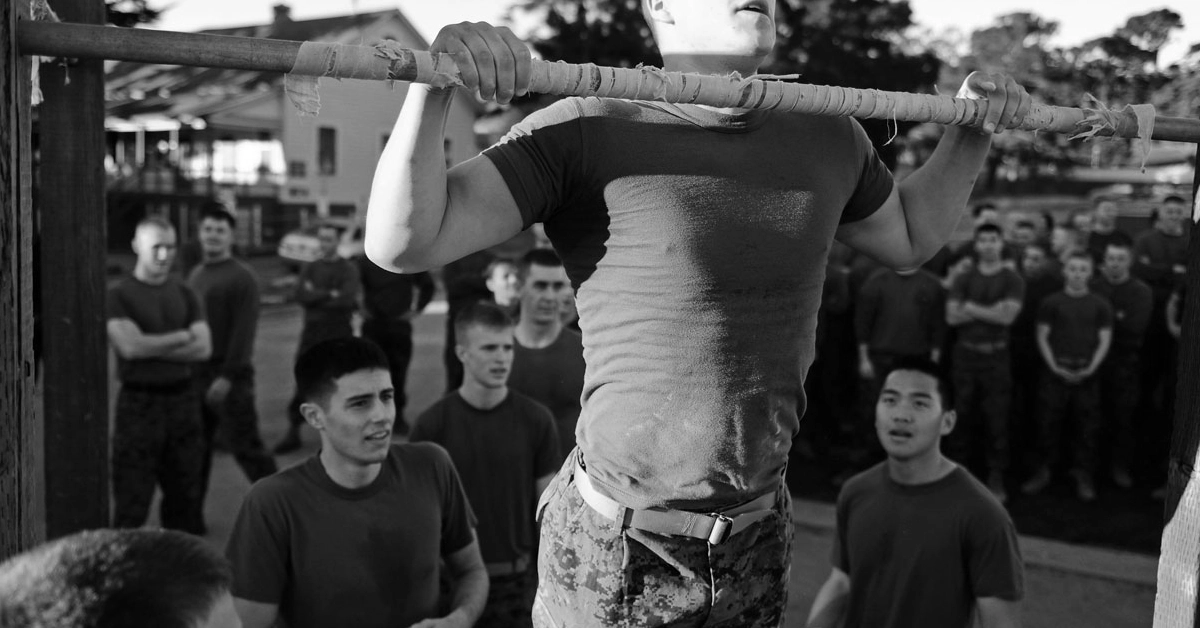
Traditional military PT — the run, push-up, pull-up, sit-up, repeat model that units have been running since roughly forever — serves one primary purpose: preparing soldiers and Marines to score well on a physical fitness test.
That is not nothing. But it is not nearly enough.
The military’s own research backs this up. A peer-reviewed study on strength training for warfighters noted that a program designed to meet the specific demands of the soldier should include compound movements like squats, deadlifts, presses, and pulls; free weights over machines; movements that mirror natural patterns; varied resistances and loads to maximize motor unit recruitment; and a flexible, non-linear approach that accommodates the daily demands of military life.
In other words — the research the military cites in its own literature looks a lot like what “commercial fitness programs” have been doing for years.
What the Warfighter Actually Needs
Set aside the PFT for a moment and ask a more useful question: what does this person need to be able to do?
The answer is not complicated. A military member — regardless of MOS or billet, because every Marine is a rifleman and every soldier may need to drag a casualty to cover — needs:
- Strength and power to move loads, people, and equipment
- Aerobic capacity to sustain effort over extended periods
- Anaerobic capacity to operate at high intensity in short bursts
- Speed, agility, coordination, and balance
- The stamina to keep performing under physical and mental fatigue
- Mobility to move well and avoid injury across a career
This is the definition of General Physical Preparedness — being competent across a broad range of physical demands, not elite at one. The CrossFit framework identified this years ago, and the military’s own research has since validated it: the warfighter needs to move a large load, a long distance, and do it quickly.
The traditional PFT does not train this. It trains a very narrow slice of it and creates athletes who can score well on the test while falling apart under a ruck.
The Periodization Problem
The argument against “commercial fitness programs” in military circles usually invokes periodization — the idea that a properly planned training cycle, with defined phases and a peak, is superior to varied or seemingly random programming.
In theory, periodization is excellent. In the context of military life — mandatory PT, unpredictable schedules, deployment cycles, missions that do not care about your mesocycles — it is often impractical.
Research by Souza et al. (2014) looked at periodized versus non-periodized strength training over six weeks and found that the non-periodized group improved maximal strength significantly more than the periodized group. Other research has noted that a flexible non-linear program may actually be more beneficial for military populations precisely because daily demands constantly change.
This does not mean random training is better than planned training. It means that rigid periodization often breaks down against real military life — and a well-designed program with built-in flexibility, guided by experienced programming, tends to outperform a theoretically perfect program that cannot be executed consistently.
What Smarter Training Looks Like
The principles are not complicated:
Build a broad base of general fitness. Strength, conditioning, endurance, mobility, power — all of it, developed consistently over time. The GPP framework post covers what this looks like in practice.
Replace long slow distance with high-intensity intervals. The research is clear that short, hard interval work drives better aerobic adaptation with less injury risk and less interference with strength development. More miles is not the answer — smarter miles are.
Prioritize strength. Stronger athletes are up to five times less likely to suffer stress fractures during training. Strength is the foundational quality that makes everything else more durable. How to get strong covers the principles.
Use a flexible program that fits your actual life. If you feel terrible on Tuesday, scale back. If the training is consistently wrecking you, something is wrong with the program — not with you. The goal is optimal training, not the hardest possible training. As stress management and cortisol research shows, grinding through training on top of chronic stress produces worse results, not better ones.
You are not a professional athlete whose entire day revolves around eating, training, and sleeping. You need a program built for people with real jobs, real schedules, and a career that requires consistent performance — not a program designed to peak you for a competition at the expense of everything else.
If you want a complete program built on these principles — strength, conditioning, endurance, and mobility structured to work together — the Strategic Foundations Training Team is the starting point. Fourteen days free.
References
Kraemer, W., & Szivak, T. (2012). Strength training for the warfighter. Journal of Strength and Conditioning Research, 26(7), S107–S118.
Souza, E. O., et al. (2014). Early adaptations to six weeks of non-periodized and periodized strength training regimens in recreational males. Journal of Sports Science & Medicine, 13(3), 604–609.