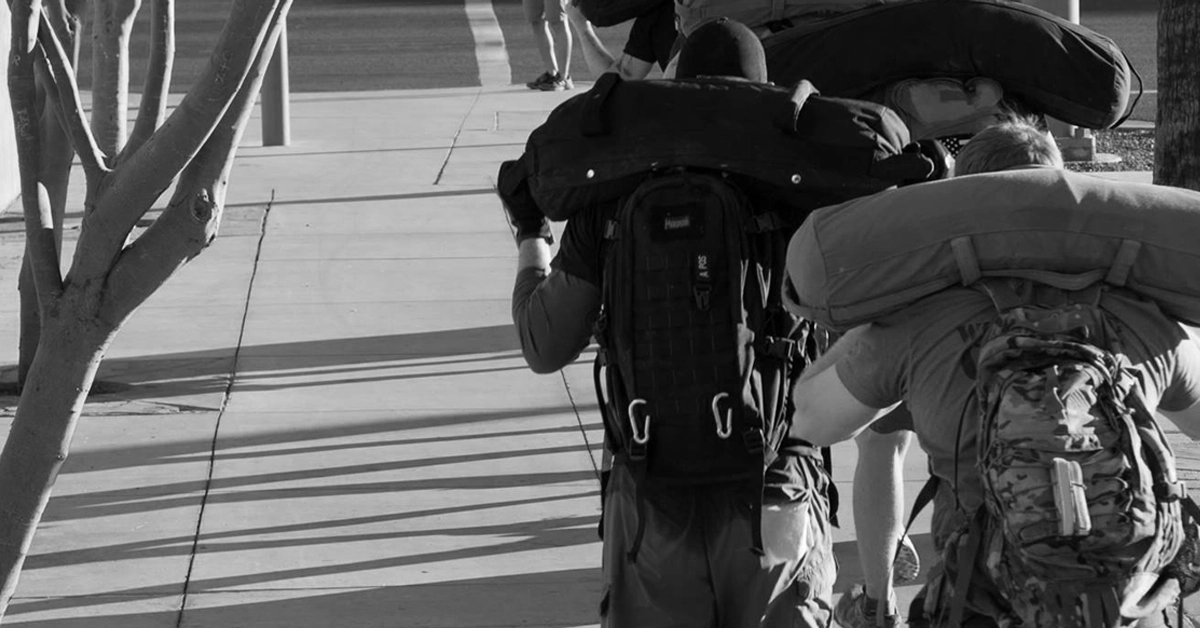
The Foundation of Ruck Training: 3 Exercises That Actually Move the Needle
Rucking is apparently a trendy fitness concept now. Those of us who were required to do it as part of a job description find this mildly entertaining.
For anyone still doing it — whether for an event, a selection, or because it is Tuesday — the most common mistake is training for it by doing more of it. More miles, more load, more time under the pack. That works to a point and then stops working. It also produces a predictable set of overuse injuries.
The better approach: build the strength foundation that makes rucking sustainable, efficient, and less likely to break you. That foundation comes down to three exercises.
1. The back squat
If I could pick one exercise for every athlete regardless of their goal, it is the back squat.
Want to get stronger? Squat. Want to get faster? Squat. Want to ruck farther with less suffering? Squat. The back squat builds the lower body strength and power that carries over to everything else — and the research supports it for both strength and speed development.
It is also one of the best movement screens available. Watch someone squat and you will find their mobility limitations, stability deficits, and motor control weaknesses faster than almost any other assessment.
One important note: mechanics before intensity. Do not load up a barbell and grind through ugly reps hoping weight will fix the problem. It will not. Start with clean movement, earn the load. The progression post covers the full rationale for why this sequence is non-negotiable.
2. The walking lunge
When intermediate athletes plateau on their squat and deadlift, the weak link is almost always unilateral glute strength. The walking lunge is one of the best tools for fixing that — and requires zero equipment to get started.
Unloaded walking lunges build muscular endurance at high volume, which is exactly what you need to carry a heavy pack over rough terrain for hours. Add load — barbell, dumbbells, kettlebells, sandbag, or the actual ruck — and you are building serious unilateral strength and stability that transfers directly to the loaded movement demands of long rucks.
The lunge is underused because it is unglamorous. That is exactly why it works.
3. The kettlebell swing
If you have finished a long ruck with tight hips and a destroyed lower back, the kettlebell swing is the prescription.
Performed correctly, the swing activates the entire posterior chain — glutes, hamstrings, spinal erectors — and develops explosive hip extension, which is the engine behind efficient loaded movement. Research has shown meaningful increases in both maximal and explosive strength from kettlebell swing training, along with hormonal responses that support recovery and adaptation.
It is also one of the most effective conditioning tools available for people who do not want to run more miles.
If you want to improve your ruck performance without the soul-crushing volume most programs demand, the Free 5-Part Endurance Mini-Course covers the complete approach — strength work, interval structure, and how to put it together without wrecking your recovery.
The core principle
I coached CrossFit Endurance seminars for years. The consistent finding: low-volume endurance training works dramatically better when built on top of a solid strength and conditioning foundation. Without the S&C base, the low-volume approach falls apart.
I ran the GORUCK Heavy — 26+ hours — on a training base where the longest ruck in preparation was 90 minutes. That is not a boast, it is a proof of concept for what adequate strength preparation enables.
Get the squat, lunge, and swing dialed in. Build the posterior chain. Then you can talk about ruck mileage. For common injuries that derail ruck training before the foundation is built, shin splints is the most frequent one — and entirely preventable with the right approach.
References
Lake, J., & Lauder, M. (2012). Kettlebell swing training improves maximal and explosive strength. Journal of Strength and Conditioning Research, 26(8), 2228–2233.
Budnar, R., et al. (2014). The acute hormonal response to the kettlebell swing exercise. Journal of Strength and Conditioning Research, 28(10), 2793–2800.