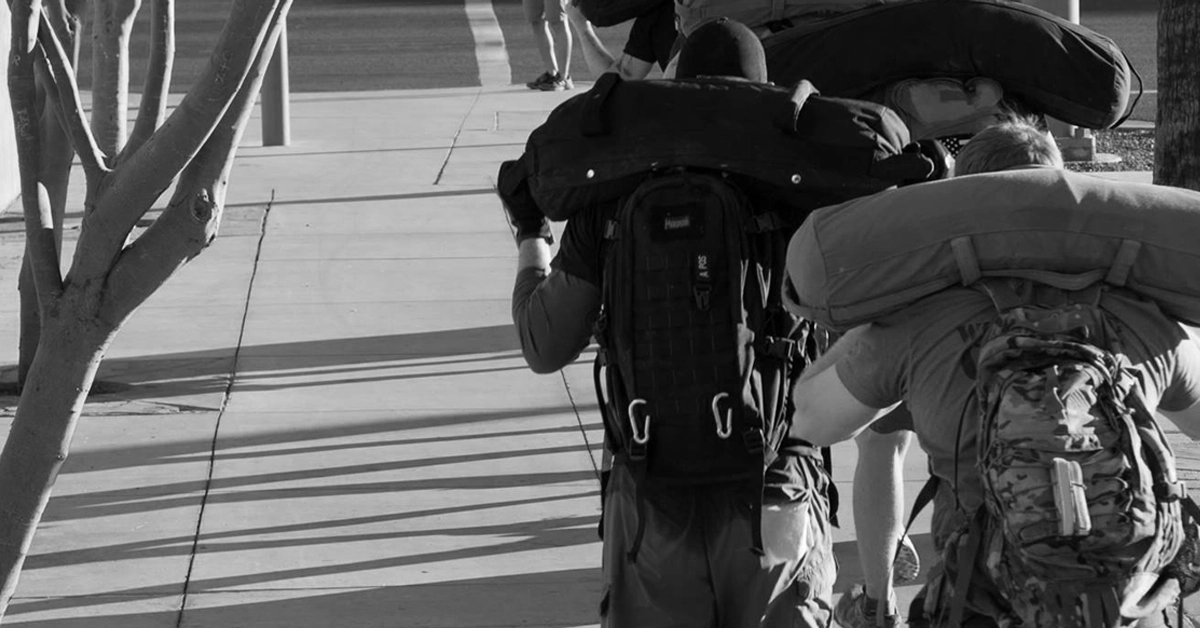
Ruck Training Without Soul-Crushing Volume: A Smarter Approach
Almost five years ago I completed my first GORUCK Challenge — and I had not put a ruck on my back a single time in training to prepare for it.
That is not advice. It is context.
The point is not that you can show up to a GORUCK event completely unprepared and survive on grit alone — though some people do. The point is that spending the majority of your training time rucking is not the only path to being ready, and for most people with actual lives, it is not even the best path.
I have completed 17 GORUCK events from Light to Heavy. I broke my left foot in ten places from repetitive long slow distance ruck training early in my career. That experience — being literally part of the statistic where non-battle injuries from overuse produce more medical evacuations than combat — is what started me down the path of minimal effective dose training.
Here is the framework that works.
Why More Rucking Is Not the Answer
The high-volume ruck training programs expect 20–30 hours of training per week from people who have jobs, families, and actual lives. Most people who have tried these programs have told me the same thing: they ran out of time and energy long before they finished the prescribed work.
That is not a discipline problem. That is a programming problem.
The research on load carriage performance supports the low-volume approach. The NSCA has noted that high-intensity, low-volume training protocols outperform high-volume, low-intensity approaches for improving load carriage performance. Intensity first. Frequency second. Volume third. This is the same finding that drives the interval-based approach to run training — the mechanism is identical.
Additionally, the research on strength and injury prevention is unambiguous: stronger athletes are up to five times less likely to suffer stress fractures during training. Spending more time rucking at the expense of strength training makes you worse at rucking, not better.
The Foundation: Get Stronger First
The most transferable thing you can do for your rucking performance is get stronger.
Stronger athletes ruck more efficiently, recover faster between training sessions, stay healthier over multi-day events, and have the physical reserve to handle the unexpected. A solid strength and conditioning foundation — squats, deadlifts, carries, pressing — is not supplemental to ruck training. It is the base that ruck training is built on.
This does not mean ignoring ruck-specific training entirely. It means sequencing it correctly: build the strength base first, then add loaded movement work on top of it. Not the other way around.
How to Structure Ruck Training
Think of ruck work as supplemental to your S&C program — sessions that develop the specific patterns and mental demands of rucking without replacing the strength and conditioning that makes those sessions productive.
Short, heavy, high-intensity ruck intervals are your primary training tool. Load up heavier than required, move at a hard pace for 20–30 minutes, recover, repeat. This matches the NSCA finding that intensity drives load carriage adaptation more than volume.
Loaded carries — farmer carries, sandbag carries, yoke work — build the postural strength, grip endurance, and midline stability that transfer directly to rucking. These can be added to the end of regular training sessions and provide significant ruck-specific benefit with minimal additional recovery cost. The strongman training post covers the specific movements that transfer best.
One longer ruck every one to two weeks serves a different purpose than fitness. Use it to test your gear, dial in your pacing strategy, practice nutrition and hydration, and build the mental callus that only comes from sustained time under load. The mechanics of efficient rucking — midline stability, forward lean, stride length — are covered in detail in the load carriage mechanics post.
Specific Considerations for Event Prep
If you are genuinely nervous about what might happen at your next event: get under a heavy load and log some miles. Not to train your body — to train your mind. Confidence under load comes from time under load. The fitness will be there from your S&C work. The mental preparation requires actual rucking experience.
For longer events (Heavy, 24+ hours): one or two longer rucks in the six weeks before your event are appropriate — specifically to test nutrition strategy and mental preparation for sustained discomfort. The longest I rucked in training for the GORUCK Heavy (a 26+ hour event) was a single 90-minute session. I finished.
The most important rule: your training program should not be sucking the life out of you before the event. If you dread training, if you are running out of time and energy before completing the prescribed work, the program is wrong — not you.
If you want to build the complete fitness base for rucking and military performance — strength, conditioning, endurance, and loaded carries structured together — the Strategic Foundations Training Team handles the programming. Fourteen days free to see if it fits.